
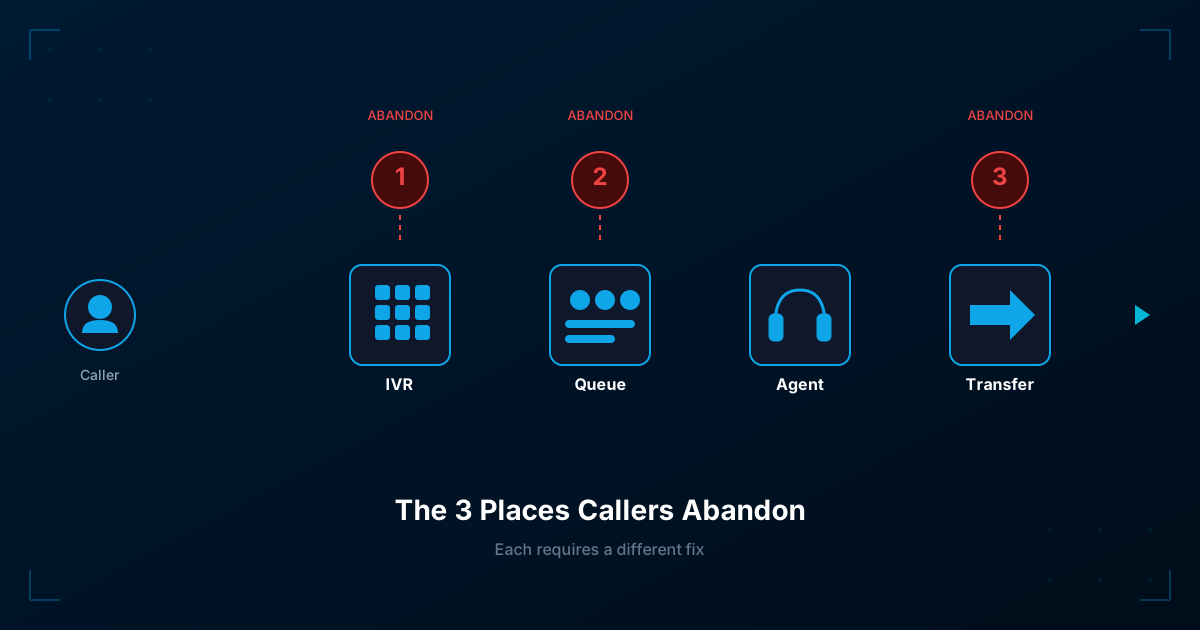
Key Takeaways: Your abandonment rate is actually three different metrics hiding in one number. Callers abandon in the IVR (fix: simplify menus, add conversational AI), in the queue (fix: offer callbacks, set wait expectations), or after transfer (fix: warm transfers, better routing). Diagnose which stage is leaking callers, then fix that specific problem.
Your abandonment rate is 6%. That sounds reasonable—the industry average hovers between 5-8%, with best-in-class contact centers achieving under 3%.
But what does that number actually tell you?
Not much. Because “abandonment” isn’t one problem. It’s three different problems happening at three different points in the caller journey. And each requires a completely different fix.
Until you know where callers abandon, you’re guessing at solutions.
The Three Abandonment Points
When someone calls your contact center and hangs up before resolution, they abandoned at one of three places:
- In the IVR — before ever reaching a queue
- In the queue — while waiting for an agent
- After transfer — when moved to another department
Most contact center platforms report a single abandonment number that blends all three. That’s like a doctor saying “something hurts” without identifying what or where.
Let’s break down each one.
IVR Abandonment: Callers Who Hang Up Before Reaching the Queue
What’s happening: Callers enter your IVR and hang up before reaching an agent queue. They never even started waiting—they gave up during self-service or menu navigation.
Why it happens:
- Too many menu options. “Press 1 for sales, press 2 for support, press 3 for billing, press 4 for technical support, press 5 for returns, press 6 for…” — by option 4, they’re gone.
- Confusing terminology. Your internal department names don’t match how customers think. “Press 2 for Customer Success” means nothing to someone who just wants to return a product.
- No clear path. They don’t know which option fits their issue, so they either guess wrong (leading to transfers) or give up entirely.
- Forced identification loops. “Please enter your 16-digit account number” when they don’t have it handy. Authentication friction before they’ve even stated their problem.
The real cost: These callers never appear in your queue metrics. They’re invisible. Your ASA looks fine, your queue wait times look fine—but you lost the customer before measurement even started. Up to 83% of customers will avoid a company after a poor IVR experience.
How to fix it:
- Simplify ruthlessly. Three to four options maximum on any menu level. If you need more, your IVR structure needs rethinking.
- Use customer language. Test your menu options with real customers. “Billing questions” beats “Accounts Receivable.”
- Offer an escape hatch. Always let callers say “agent” or press 0 to skip the IVR. Some will use it, but they’ll stay on the line.
- Deploy conversational IVR. Natural language IVR that asks “How can I help you?” and routes based on intent, not menu selections. Abandonment in conversational IVR is consistently 30-40% lower than touch-tone menus.
What to measure: Track IVR completion rate separately from queue abandonment. What percentage of callers who enter the IVR successfully reach a queue or complete self-service? If it’s below 85%, your IVR is the problem.
Queue Abandonment: Callers Who Give Up While Waiting
What’s happening: Callers made it through the IVR and entered a queue, but hung up before reaching an agent. This is what most people think of as “abandonment.”
Why it happens:
- Wait time exceeds patience. Different callers have different thresholds, but industry data shows the average caller waits only 2 minutes and 18 seconds before hanging up. After 5 minutes, abandonment rates can exceed 30%.
- No information. Silence is abandonment fuel. Callers with no position update or estimated wait time assume the worst.
- No alternatives offered. If they knew they could get a callback or switch to chat, they might stay. But they don’t know, so they leave.
- Bad hold experience. Repetitive music, frequent “your call is important to us” interruptions, or worse—ads. Every annoyance shortens their patience.
The real cost: These callers consumed IVR resources, occupied queue slots, and then left with a negative impression. They might call back (creating repeat volume) or they might defect to competitors.
How to fix it:
- Offer callback. This is the highest-impact, lowest-effort fix. “Press 1 to keep your place in line and receive a callback” converts abandonment into scheduled contacts. Callbacks achieve 90%+ connection rates and reduce abandonment by up to 32%.
- Set expectations. “Your estimated wait time is 4 minutes” or “You are caller number 3” reduces uncertainty. Even bad news is better than no news.
- Channel deflection. “For faster service, press 2 to continue this conversation via text message.” Move willing callers to async channels where wait perception is different.
- Intelligent queue prioritization. Not all callers should wait equally. High-value customers, repeat callers on the same issue, and callers with urgent signals (detected via IVR or AI) should move up.
What to measure: Segment abandonment by wait time buckets. What percentage abandon at 0-1 minutes? 1-3 minutes? 3-5 minutes? 5+ minutes? If abandonment spikes at a specific threshold, you’ve found your intervention point.
Transfer Abandonment: Callers Who Drop Off During Handoffs
What’s happening: A caller reached an agent, but that agent couldn’t help and transferred them. The caller then abandoned during or after the transfer.
Why it happens:
- Cold transfers. Agent says “let me transfer you” and the caller enters a new queue with zero context. They’ve already waited once; waiting again—while also having to repeat their story—breaks them.
- Wrong department. They get transferred, reach someone, explain their issue again, and hear “actually, you need a different team.” At that point, hanging up feels like the only sane choice.
- Transfer queue is longer. The specialized queue they’re transferred to has a 15-minute wait. They already spent 5 minutes in the first queue. They’re done.
- Repeated transfers. The dreaded “transfer loop” where they bounce between departments. By transfer #3, they’ve abandoned mentally even if they haven’t hung up yet.
The real cost: This is the most expensive abandonment. You’ve already invested IVR time, initial queue wait, and agent handle time—then lost the customer anyway. Studies show 68% of customers leave due to poor service experiences, and transfer failures are among the top complaints. These callers are the most likely to churn and the most likely to leave negative reviews.
How to fix it:
- Warm transfers only. Agents should connect with the receiving agent before transferring, provide context, and introduce the caller. “I have Sarah on the line who needs help with X, I’ve explained Y, she just needs Z from you.”
- Skills-based routing from the start. If your IVR and routing are working correctly, most transfers are unnecessary. Invest in getting callers to the right agent the first time.
- AI-assisted routing. Use intent detection to route complex calls to agents with the right combination of skills, reducing the need for transfers.
- Unified agent desktops. When agents can handle multiple issue types without transferring, transfer volume drops naturally.
What to measure: Track post-transfer abandonment as its own metric. What percentage of transferred calls result in abandonment? If it’s above 10%, your transfer process needs work. Also track transfer rate overall—every transfer is a routing failure.
Why Aggregate Abandonment Rate Is Misleading
Consider two contact centers, both with 6% abandonment:
Contact Center A:
- 2% abandon in IVR
- 3% abandon in queue
- 1% abandon after transfer
Contact Center B:
- 0.5% abandon in IVR
- 2% abandon in queue
- 3.5% abandon after transfer
Same headline number. Completely different problems.
Contact Center A has an IVR issue—their menus are too complex, their self-service is failing, callers can’t find their way.
Contact Center B has a routing and transfer issue—callers get through fine but end up with the wrong agent and give up during handoffs.
The solutions are entirely different. A needs IVR redesign. B needs better skills-based routing and warm transfer protocols.
If you’re only looking at aggregate abandonment rate, you’re flying blind.
How to Diagnose Your Abandonment Problem
Step 1: Segment your data.
Pull abandonment numbers for each stage:
- IVR abandonment (calls entering IVR minus calls reaching queue or self-service completion)
- Queue abandonment (calls entering queue minus calls reaching agent)
- Transfer abandonment (transferred calls minus transferred calls reaching resolution)
Step 2: Find the biggest number.
Which stage accounts for the most lost callers? That’s where you start.
Step 3: Drill into timing.
For queue abandonment, when do people give up? The wait-time distribution tells you whether you need more capacity, better callback options, or better expectation-setting.
Step 4: Listen to abandonment points.
Pull recordings or transcripts of calls that ended in abandonment. What was the last thing the caller heard? IVR menu option 6? “Please continue to hold”? A transfer announcement? The patterns will emerge.
Step 5: Fix one thing.
Don’t try to solve all three abandonment points at once. Pick the biggest impact area, implement one change, measure results, then move to the next.
The Bottom Line
Abandonment is not a single metric. It’s three different failure modes at three different points in the customer journey.
IVR abandonment means your self-service is failing before callers even try to reach an agent.
Queue abandonment means callers are willing to wait—up to a point—and you’re exceeding that point.
Transfer abandonment means your routing sent callers to the wrong place, and they’re paying the price.
Until you know which problem you’re solving, you can’t solve it. Break down your abandonment data, find the leakage point, and fix that specific problem.
Your overall abandonment rate will follow.
Frequently Asked Questions
What is a good call abandonment rate?
Industry benchmarks suggest 5-8% is average, but best-in-class contact centers achieve under 3%. However, the “right” rate depends on your industry, call complexity, and customer expectations. More important than the absolute number is understanding where abandonment happens and whether it’s improving over time.
How do you calculate call abandonment rate?
The basic formula is: (Abandoned Calls / Total Incoming Calls) x 100. But this aggregate number hides more than it reveals. Break it down by stage: IVR abandonment (calls entering IVR minus calls reaching queue), queue abandonment (calls entering queue minus calls answered), and transfer abandonment (transferred calls minus transferred calls resolved).
Why do customers abandon calls?
The reasons vary by stage. In the IVR: confusing menus, too many options, or forced authentication. In the queue: excessive wait times, no estimated wait information, or poor hold experience. After transfer: cold transfers, wrong department routing, or having to repeat their issue. Each requires a different solution.
What is the average wait time before callers hang up?
Research indicates the average caller waits approximately 2 minutes and 18 seconds before abandoning. However, patience varies significantly by context—callers with urgent issues or high-value transactions will wait longer, while simple inquiries have shorter thresholds.
How can I reduce call abandonment quickly?
The fastest wins are typically: (1) offering callback options in the queue, which can reduce abandonment by 30%+, (2) providing estimated wait times to set expectations, and (3) ensuring warm transfers instead of cold transfers. Start by identifying which stage has the highest abandonment, then focus there.
Does IVR design affect abandonment rates?
Significantly. Complex IVR menus with more than 4-5 options per level, confusing terminology, or required authentication before stating the issue all drive callers to hang up. Conversational IVR using natural language processing typically sees 30-40% lower abandonment than traditional touch-tone menus.
Want to see where your callers are dropping off? Explore Platform28’s Analytics →
Ready to fix routing issues at the source? Learn about Intelligent Routing →
Building an inbound operation from scratch? See our Inbound Call Center Solution →